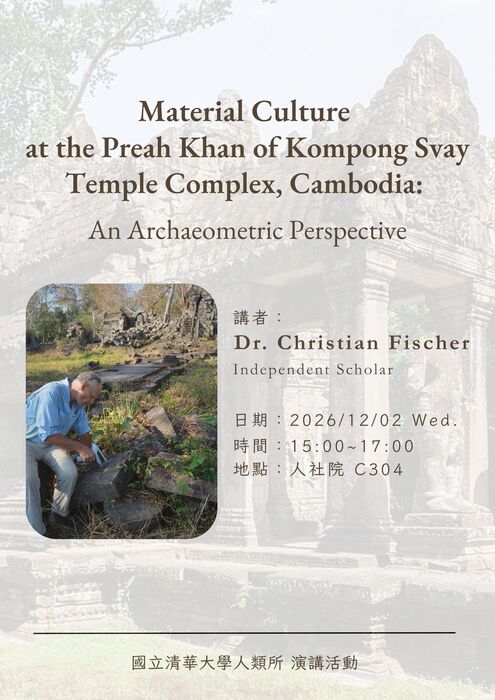
演講主題:Material Culture at the Preah Khan of Kompong Svay Temple Complex, Cambodia: An Archaeometric Perspective
講者:Dr. Christian Fischer
(Independent Scholar)
時間:2026年12月2日,下午3點至5點
地點:人社C304
報名表單填寫:https://forms.gle/
講題大綱:
Located approximately 100 km east of Angkor, the temple complex of Preah Khan of Kompong Svay offers a unique opportunity to investigate technological, cultural, and religious transformations during the Angkorian period through the scientific study of its material culture. Within the framework of the Two Buddhist Towers project, a variety of cultural materials, including architectural stone, traces of paint, coins, and other metal and stone artifacts, were investigated both in situ and in the laboratory. The analytical strategy combines non-invasive, field-deployable techniques, such as portable X-ray fluorescence (pXRF) and fiber-optic reflectance spectroscopy (FORS), with optical and electron microscopy (petrography, SEM-EDS), alongside advanced imaging and documentation methods, including reflectance transformation imaging (RTI) and 3D modeling. Drawing on selected case studies, this presentation will highlight the complementarity, potential, and limitations of these techniques in addressing questions related to the nature and provenance of materials, with particular emphasis on stone procurement, pigment composition and painted decoration, the characterization of coins, as well as technological practices and ritual activities. Beyond material characterization, the integration of scientific data with evidence from archaeological excavations, architectural observations, and epigraphic sources has contributed to a better understanding of the construction history of the temple complex, its successive occupations, and the transition from Mahāyāna to Theravāda Buddhism.
This multidisciplinary approach has also shed light on human-induced alterations, particularly looting practices and their impact on the archaeological and architectural record, with broader implications for the documentation and preservation of the site.