14/06/04 演講: The Rebel of Trickster and the Ironies of Contemporary Mainland China
各位老師、同學:
本次演講很榮幸請到奧斯陸大學社會人類學系的Susanne Ellen Brandtstädter教授為大家帶來演講,歡迎大家參與聆聽,以下是演講資訊,演講參考文章請看附件。
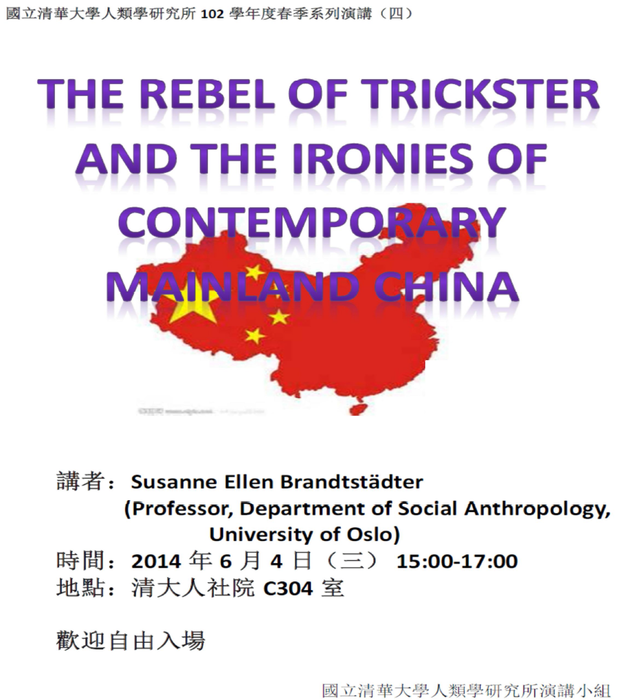
演講題目:The Rebel of Trickster and the Ironies of Contemporary Mainland China
講者:Susanne Ellen Brandtstädter (Professor, Department of Social Anthropology, University of Oslo)
時間:2014年6月4日(三) 15:00-17:00
地點:清大人社院C304室
講題簡介:
In this paper, I analyze the political poetics – the distinct political style and strategies – of contemporary peasant lawyers and rural resistance experts in China to argue that they resemble a political trickster: a political actor who exploits the ambiguities of “governing through law” (fazhi) in order to expose systematic administrative abuse, who subverts authority through an ironic take on state discourse, and who defies categorization by uniting moral and political opposites in one person. I argue that irony has developed as a resistive genre in post-Maoist China because it is a highly effective way of revealing and criticizing the self-referential nature of slogan politics as political betrayal in post-Maoist China. Rather than being simply a strategic adaptation to a repressive state, such political trickery can deflect state power and at the same time reveal the gap between ideals and reality – a gap in which politics proper can arise.
歡迎自由入場
國立清華大學人類學研究所演講小組 敬上
本次演講很榮幸請到奧斯陸大學社會人類學系的Susanne Ellen Brandtstädter教授為大家帶來演講,歡迎大家參與聆聽,以下是演講資訊,演講參考文章請看附件。
演講題目:The Rebel of Trickster and the Ironies of Contemporary Mainland China
講者:Susanne Ellen Brandtstädter (Professor, Department of Social Anthropology, University of Oslo)
時間:2014年6月4日(三) 15:00-17:00
地點:清大人社院C304室
講題簡介:
In this paper, I analyze the political poetics – the distinct political style and strategies – of contemporary peasant lawyers and rural resistance experts in China to argue that they resemble a political trickster: a political actor who exploits the ambiguities of “governing through law” (fazhi) in order to expose systematic administrative abuse, who subverts authority through an ironic take on state discourse, and who defies categorization by uniting moral and political opposites in one person. I argue that irony has developed as a resistive genre in post-Maoist China because it is a highly effective way of revealing and criticizing the self-referential nature of slogan politics as political betrayal in post-Maoist China. Rather than being simply a strategic adaptation to a repressive state, such political trickery can deflect state power and at the same time reveal the gap between ideals and reality – a gap in which politics proper can arise.
歡迎自由入場
國立清華大學人類學研究所演講小組 敬上
 13 Brandtstädter_Rural legal activism.pdf
分享